
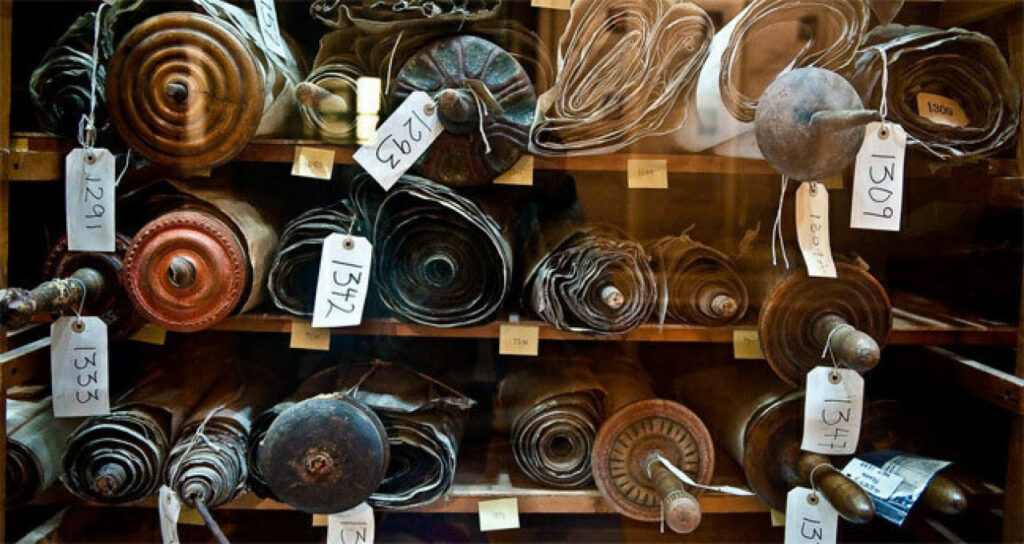
Memorial Scroll Trust Torah #706
Received on permanent loan in the 1990s. Originally belonged to the Pinkas Synagogue in Prague, built in 1535.
Memorial Scroll Trust Torah #58
Received on permanent loan in the 1990s. Originally located in Lostice, a Moravian town with a nearly 400-year Jewish history that was brought to an end in 1942.
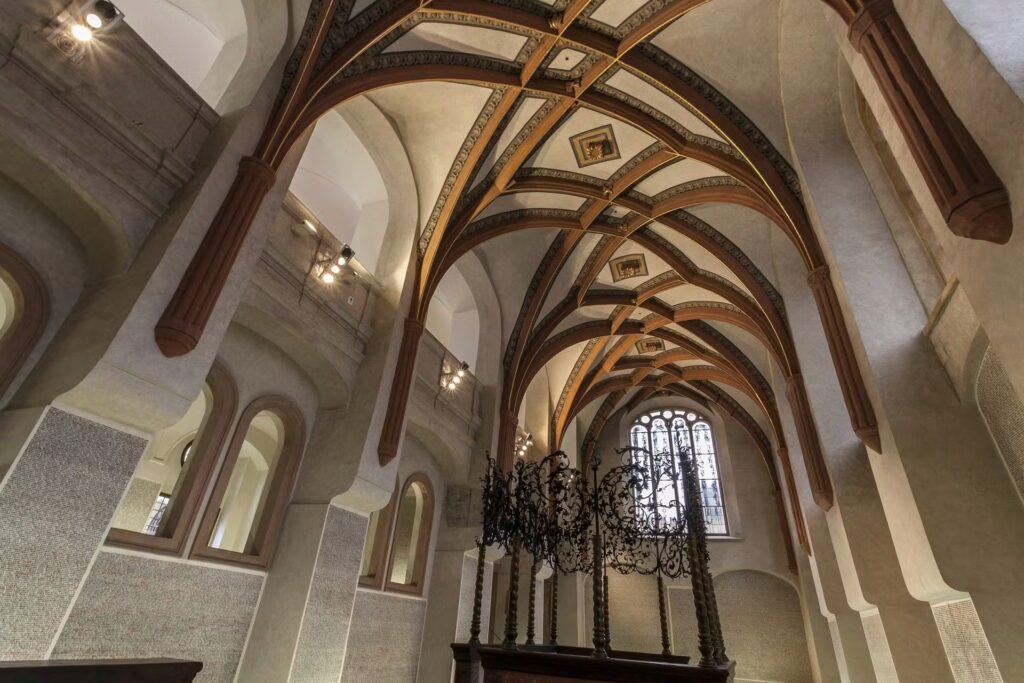
The Pinkas Synagogue is the second oldest preserved synagogue in Prague. Built in the late Gothic style in 1535, it was founded by Aaron Meshulam Horowitz and is believed to have been named after his grandson, Rabbi Pinkas Horowitz.
Originally a place of prayer for the Horowitz family, the synagogue was located near a ritual bath known as a mikveh. It was restored to its original form between 1950 and 1954.
THE HOLOCAUST IN CENTRAL EUROPE
Jews had lived in Bohemia and Moravia for more than a thousand years. Here is what happened to their communities.
Years of Jewish life in the region
Jews in Prague in 1940
Remaining by 1947
The Munich Agreement handed Germany the Sudetenland. Jewish communities across some sixty congregations had only days to flee to the interior of Czechoslovakia. The synagogues they left behind were destroyed during the November 1938 pogroms, and nearly all of their ritual treasures were lost.
Germany invaded the remainder of Czechoslovakia. Despite the occupation, synagogues and their congregations were left intact for the time being. There was no immediate program of destruction.
All Jewish congregations were formally closed down. The Jewish community administration was co-opted by the Germans to carry out a steady stream of decrees and instructions against the Jewish population.
Deportations began in 1941. Mass deportations followed throughout 1942 and into January 1943. The Nazis moved to liquidate all communal and private Jewish property, including the contents of synagogues across Bohemia and Moravia.
Dr. Stein of the Prague Jewish community wrote to all congregations instructing them to send their synagogue contents to the Jewish Museum in Prague. Torah scrolls, silver, gold, ritual textiles, and thousands of books were sent for safekeeping. This single act preserved what would otherwise have been lost forever.
The remaining Jewish population was deported in 1943 and 1944. Prague’s Jewish population fell from 54,000 in 1940 to under 8,000 by 1947, and many of those survivors chose to leave. A country that had been home to Jewish life for over a thousand years emerged from the war largely without its Jewish community.
PRESERVATION AMID DESTRUCTION
When the contents of over one hundred congregations were sent to Prague, the Jewish Museum’s inventory expanded to fourteen times its original size.
Congregations contributed their contents
Growth of the museum’s inventory
Warehouses needed to store everything
It took more than forty storage sites, many of them emptied Prague synagogues, to hold everything. When the work was complete, the Jews who had done it were deported to Terezin. Few survived.
After the war, Czechoslovakia emerged free but largely without its Jewish population. By 1958, hundreds of Torah scrolls had been moved to a warehouse in the Michle Synagogue, where they were left neglected for years.
HOW THE SCROLLS FOUND NEW HOMES
In the early 1960s, Eric Estorick, an American art dealer living in London, was approached by Czech state officials about purchasing Torah scrolls stored in the Michle Synagogue. He connected with philanthropist Ralph Yablon, who provided the funds to buy them.
Torah scrolls arrived in London
1964, arrival at Westminster Synagogue
Congregations represented
After months of sorting, examination, and cataloging, the Memorial Scrolls Trust was established to distribute the scrolls to Jewish congregations around the world, returning them to active spiritual and educational life.
Each Memorial Scroll is a messenger from a community that was lost, but does not deserve to be forgotten.